King Felix plays a Game of Thrones.

Check out my guest blog about the Mariners’ early season over at Sportsnet.ca. Felix Hernandez leads a new crop of youngsters including Dustin Ackley, Justin Smoak, Kyle Seager and Jesus Montero.

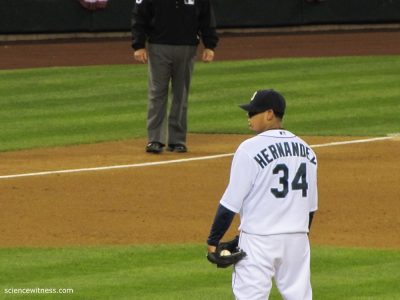
Felix Hernandez

Felix Hernandez of the Seattle Mariners


Posted in Uncategorized | Leave a comment

VIDEO: Bartolo Colon taking fly balls at Safeco Field!

It was an off day for Bartolo Colon. The previous night, he had pitched to a win over the Mariners for the second time in less than a month. During pre-game warmup, the Oakland A’s were taking batting practice and there was one unexpected face in center field. That face, it turns out, was the aforementioned 300lb pitcher taking his turn catching fly balls. This wasn’t Mariano Rivera shagging flies. No, not a lot of ground was covered, but pretty good for that, um… body frame.

Posted in Baseball | Leave a comment

Sounders FC beat Colorado Rapids 1-0.

On a beautiful Saturday afternoon, the Seattle Sounders FC hosted the Colorado Rapids.


Photos from Sounders FC game against the Colorado  Rapids.

Brian Mullan was booed every time he touched the ball. After one hard tackle, the Sounders reacted strongly with Fredy Montero challenging the man who broke Steve Zakuani’s leg. For most of the game, both defenses outclassed the offensive attackers. In fact it was defender Zach Scott who headed in a corner to give the Sounders the win. Read the postgame comments in the Seattle Times game summary.

Posted in Uncategorized | Leave a comment

London Olympics: stories and subplots

The 2012 London Olympics are fast approaching. As always, there is no shortage of stories or subplots.

- Queen Elizabeth II will open the London Olympics, her first since she opened the games in Montreal in 1976.

- In Soccer, both the men’s and women’s US national teams are playing in fine form. The women are 8-0 in 2012 and qualified easily for London. The US continues to reload the roster and will be tough to beat. The men, meanwhile, are coming off a historic win over Italy on Italian soil. Signs are positive that the changes new German coach Jurgen Klinsmann implemented are beginning to pay off.

- Team USA released its new uniform design for its basketball team. The team is primed with the core of the 2008 gold medal “Redeem Team” returning along with a new wave of all-stars headlined by the phenom Kevin Durant. A rematch with Spain may await in London.


- Speaking of uniforms, the International Amateur Boxing Association (AIBA) recently changed its rules to allow female competitors to wear skirts if they so choose. Although most western boxers are resistant to the idea, some Eastern European boxers tried wearing skirts at the European Championships. The issue is sure to raise eyebrows in a sport that struggles against sexism. For example, Cuba refuses to send a female boxing team to London because it considers it unbecoming for women.

- Japanese rider Hiroshi Hoketsu may become the oldest olympian at the age of 71. The two time olympian has earned an individual dressage slot to represent Japan.

- And of course there is Michael Phelps. In what is expected to be his final games, the US swimmer is beginning to ramp up his intensity as London approaches. Phelps has not announced how many events he plans to enter, preferring to wait until he approaches the US trials.


Posted in Olympics | Leave a comment

Videos of Ichiro Suzuki’s new vs. old batting stances

In 2011, the Seattle Mariners offense was historically bad. The team ranked last in Major League Baseball for runs scored and their team batting average sat at 0.233! Their offensive struggles were so pronounced that GM Jack Zduriencik was compelled to trade phenom pitcher Michael Pineda for Yankees slugging prospect Jesus Montero.  Now, manager Eric Wedge enters the 2012 season with plans to move outfielder Ichiro Suzuki from his traditional leadoff spot. Much has been made about Ichiro’s batting practice power displays over the years and with his declining on-base percentage, the thinking is that Ichiro can drive in runs while allowing Chone Figgins to return to the leadoff position. This spring, Ichiro is preparing to hit third, a spot that he hit from during his time in Japan (and won several batting titles). Interestingly, spring training observers in Arizona have noticed a change in his famous batting stance, specifically a widening of his base.

See Ichiro’s old stance from last spring:

and Ichiro’s new stance this spring:

This change in batting stance is a monumental challenge for the Mariners veteran. If Ichiro can reinvent himself as a number three hitter at his age, it would rank as one of the biggest baseball stories of the year. Paul Molitor comes to mind as one player who made the transition from leadoff to batting third late in his career. Molitor provided high average (0.332) and decent power (22 homeruns) while driving in 111 runs for the Toronto Blue Jays at the age of 36. If Ichiro can approach those numbers, the Mariners offense stands to be much improved.

Last year Ichiro’s game started to show the first, but inevitable signs of age. Consequently, Mariners fans are now waiting to see what adjustments the veteran has implemented during the offseason to adapt his game to a changing skill set. Over at FanGraphs, it seems that there is some evidence that Ichiro’s speed remained elite in 2011. Certainly his base stealing ability was still present (40SB vs.  7CS), but in the field Ichiro made many uncharacteristic errors. The outfielder was clearly not getting to as many balls as he used to and seemed to be getting terrible jumps on balls, almost as if his eyesight was the problem. On the offensive side, it was also unclear what caused such a sharp drop in his famed consistency. Ichiro’s success has been closely linked to his bat control and his unique ability to hold back his wrists giving him a fraction of a second more to see the ball. Combined with his corkscrew stance, I always thought that when Ichiro finally gave in to old age, it would manifest itself in his bat control and a hole in his swing on the outer part of the plate. I haven’t seen any data to support this conjecture, but I would really like to see a professional scouts take on Ichiro.

For Ichiro, the other statistical trend in 2011 was a drop in Batting Average on Balls in Play (BAIP), which is usually thought to be largely out of the control of the player. However, it was clear that Ichiro just wasn’t hitting the ball as sharply in 2011, so the drop in BAIP seemed an obvious result. In the second half of the season, Ichiro began hitting the ball harder and his average bounced back. This year, Ichiro will be geared up to swing away on more balls, so it will be interesting to see how his BAIP, average and power respond. Much of Ichiro’s game, like the man himself, remains an enigma and makes him ever more watchable in 2012.

Posted in Baseball | Leave a comment

The NHL in Seattle: Can Key Arena provide a temporary home?

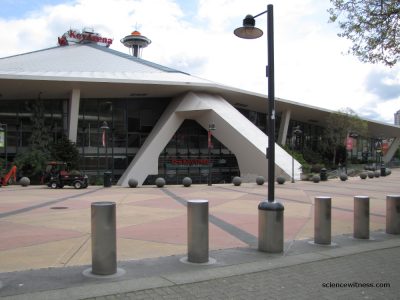
Key Arena

Key Arena in Seattle, Washington

Last week, the City of Seattle and King County announced that Seattle native Christopher Hansen has submitted a proposal to build a new arena to host future NBA and NHL teams. Hansen will raise $290 million privately to pair with $200 million in public funds. Any additional cost overruns will be the responsibility of private investors. Public funding will be accounted for through revenue generated by the new arena, thus avoiding any new tax burden on the public. Importantly, the proposal bypasses the need for any funding at the state level and is essentially paid for by user fees in Seattle only.

The new arena is planned to be built in a region of Seattle near CenturyLink Field (Seahawks & Sounders) and Safeco Field (Mariners). One of the main concerns about this location revolves around traffic. The arena would be near arteries that supply the Port of Seattle, so some thought must be made about methods to prevent any slowing of commerce. Parking is also an issue with garages at Safeco and CenturyLink fields providing 2000 stalls each.  By comparison, the Rogers Arena in Vancouver provides 7000 stalls within a 15 minute walk. Planning will need to minimize the overlap in events among the five teams that play in the area (see schedule below).  Avoiding NFL and MLS games should not be difficult due to the low number of home dates for these teams. The Mariners, however, will require a number of home dates that may overlap with the NBA and/or NHL. Since all three typically have night games during the week, there will surely be times when events are happening at both venues. As it stands, Seattle’s Department of Planning and Development requires teams at CenturyLink and Safeco to plan a minimum of 4 hours between the end of one event and the start of another. With the addition of two more teams, it would seem difficult to maintain compliance.

General schedule of professional sports in Seattle

Traffic and parking aside, an important question is where exactly would a new NBA/NHL team play until a new arena is built? The most obvious choice is Key Arena (see photo). Built in 1962 for the World’s Fair, Key Arena underwent major renovations in 1994. As a basketball facility, a new NBA team should be able to play there temporarily, but NHL hockey might be a different issue. When configured for hockey, Key Arena provides only 9,000 unobstructed seats (and 58 luxury suites). I have played hockey at Key Arena and can confirm that the dressing rooms will require some renovating before they are close to suitable by NHL standards. Although two junior teams, the Seattle Thunderbirds and Everett Silvertips play in buildings designed for hockey, both are on the smaller side for NHL crowds (6,500 and 8,300 respectively). The Tacoma dome can accommodate large crowds for hockey, but it is unlikely that the city of Seattle will allow a team to locate outside city limits (Everett is 30 minutes north of Seattle, Tacoma 45 minutes south). No, the Key Arena is almost certainly the venue to be chosen as the city has no major tenant for it now or in the foreseeable future (unless you count the Seattle Storm). Some voices, including Mariners transportation director Susan Ranf even suggest that the Key Arena should be redeveloped as a permanent site for any incoming NBA/NHL teams.

Key Arena in Seattle

So, can a venue like Key Arena host a NHL team for 1 or 2 years while a modern arena is being constructed? In Quebec City, there are estimates of annual losses in the range of $20 million for a team that stays in the 15,000 seat Colisee with its lack of luxury boxes. However, many teams have made small venues work on a temporary basis. Before the Shark Tank was built, the San Jose Sharks played in the Cow Palace (1991-1993), an arena that seated just over 11,000. Likewise, the Tampa Bay Lightning played their first year (1992) in the 11,000-seat Expo Hall before moving to the much larger Thunderdome.  The Carolina Hurricanes played two years (1997-1999) at Greensboro Coliseum (23,000 seats), where they averaged just 8,637 fans. So, there does seem to be a precedent for arenas of this size, but the question depends largely on the magnitude of financial loss that the new owners are willing to absorb while a new venue is built.

And finally, there is the question of whether Seattle has enough fans to support an NHL team. There exists surprisingly little hockey culture in Seattle, especially when one considers how close to the Canadian border we are.  The two main recreational leagues (Greater Seattle Hockey League and Cascade Hockey League) together include about 120 teams, though the vast majority are beginners. The Seattle Jr. Totems (“Totems” is my early pick for NHL team name) are the travel team for minor hockey players and the University of Washington has a club team. There are few arenas in Seattle and even those are found almost exclusively on the outskirts of town. Within Seattle itself, there are no hockey arenas to be found (see map).


View Larger Map

The two junior teams draw small, but respectable crowds (see table below). Canadian WHL teams draw slightly larger crowds in cities with established NHL teams. The $200 million dollar question is whether Seattle can be a hockey town. The Seattle Sounders Football Club exceeded all expectations when they began play, though it can be argued that there was more soccer tradition in the city given the mild weather year round. The Vancouver Canucks would be a natural rival to be sure, and I have noticed that many Vancouver fans come down for Giants games in Everett and Seattle, so presumably this spillover would help an NHL team as well.

      Team                                      2011-2012 Average Attendance

  • Seattle Thunderbirds         4862
  • Everett Silvertips                 4922
  • Calgary Hitmen                    6266
  • Vancouver Giants                6000
  • Edmonton Oil Kings           5007

So, a new movement is afoot to build an arena and entice NBA/NHL teams to come to Seattle. Much work on the arena, NBA and NHL fronts awaits, but the sad Seattle sports scene finally has some positive news. Can a NHL team make Key Arena work? Can they fill Key Arena when they get here? Will Seattle support a professional hockey team long term? These are all important issues to consider for a new NHL team in Seattle, but just because there’s a goalie doesn’t mean we can’t score.

Is the NHL coming to Seattle? The Soctiabank Saddledome, home of the Calgary Flames

Posted in Basketball, Hockey | 4 Comments

Urchin feeding

Sea urchins feed on kelp using a set of 5 teeth called the Aristotle’s lantern. As they eat their food, they leave these little star shaped chew marks. This piece of bull kelp (Nereocystis) was fed to several green sea urchins at Friday Harbor Labs.


Posted in Science | Leave a comment

Losers of the Yu Darvish posting: Seattle Mariners.

Word Tuesday morning (in Japan) is that the Texas Rangers have secured the rights to negotiate with pitcher Yu Darvish of the Hokkaido Nippon-Ham Fighters. The Rangers reportedly made a $51.7 million bid, exceeding the $51.1 that the Boston Red Sox bid for Daisuke Matsuzaka. The Rangers, who have made the World Series in back to back years, came up short both times and are looking retool for another run. This offseason, however, the Angels have raised the stakes by signing superstar first baseman Albert Pujols and starting pitcher CJ Wilson. Signing Darvish makes sense for the Rangers in the sense that it helps replenish a starting rotation that has lost Cliff Lee and C.J. Wilson in consecutive years.

Yu Darvish

Darvish should sign for something in the neighborhood of $70 million, bringing the total cost well north of $100 million for a pitcher that has yet to play in the MLB. His tall frame and 94-95 mph fastball suggest that Darvish possesses both the stuff and resiliency to succeed at the major league level. An interesting analysis looking for MLB comparisons for Darvish forwards Jordan Zimmerann as a good candidate (can be found over at Fangraphs).

The addition of Darvish would push Alexi Ogando to the pen, leaving a solid rotation that would look like:

• Yu Darvish 25
• Derek Holland 25
• Colby Lewis 28
• Matt Harrison 26
• Neftali Feliz 23

Initial reports had the Toronto Jays winning the posting for Darvish. Now that they have fallen short, the Jays are thought to be the big losers, left with a young, but promising stable of starting pitchers:

• Ricky Romero 27
• Brandon Morrow 27
• Jesse Litsch 26
• Brett Cecil 25
• Kyle Drabek 24
• Henderson Alvarez 21

The Jays were clearly looking for something big to catch up with the rest of the AL East, and international free agents represent a good way to gain ground fast. However, the biggest positive for the Jays is that Darvish didn’t land in either Boston or New York. Romero, Morrow and Alvarez are the core of a rotation that can compete in the AL East and their lineup includes Bautista and some promising youngsters. Ultimately, the Jays must now turn that money towards the trade market looking to shore up their roster. Ten games out of a wildcard spot in 2011, the Jays will have to settle for incremental improvements and the development of their youngsters.

No, the biggest losers from this signing are the Seattle Mariners. Power has tilted towards the AL West, but talent has poured into the Angels and Rangers clubhouses exclusively. Whereas the A’s have made an art form of tearing down and betting on the next cohort of youngsters, the Mariners are now caught in no-mans-land. In the midst of a major rebuilding effort, the Mariners have torn down their roster and suffered through back-to-back 100 loss seasons. Last year, many of their young prospects started showing signs of progress highlighted by second baseman Dustin Ackley and pitcher Michael Pineda. The rotation is taking shape with Felix Hernandez, Justin Vargas, Pineda, Blake Beavan and possibly rookie Danny Hultzen. The focus is now on getting any help for a historically bad offense. In 2011, the Mariners scored 556 runs, 300 less than the 855 that the Rangers scored. The teams allowed the same number of runs against, but the disparity on offense contributed to the Mariners landing 29 games behind the division leading Rangers.

In response to their anemic offense, it has been rumored that the Mariners are focusing on Prince Fielder to bolster their lineup. Although Mariners GM Jack Zduriencik has connections to Fielder from his days with the Brewers, Seattle is far from Fielder’s Orlando home. The Mariners may need to significantly overpay to convince Fielder to come to the Pacific Northwest. Unfortunately for the Mariners, the moves by the Rangers and Angels have changed the rules of the game. Seattle must improve their offense, but it may take more than just adding Fielder. A month ago, one could argue that the addition of Fielder would boost the offense enough that their pitching could win a number of games. But the gap between Seattle and Texas/LA is much larger today and the Mariners need more help than any one player can provide. A combination of moves is required, leaving some very difficult decisions to be made.

First, can the Mariners sign Fielder? Well, first they need to overpay. Luckily the Mariners have some resources that they can pull from (See “Seattle Mariners In Line To Get Huge Increase In TV Rights Fees“ http://www.forbes.com/sites/mikeozanian/2011/12/19/seattle-mariners-in-line-to-get-huge-increase-in-tv-rights-fees/). The team is owned by Nintendo and have not asked for an infusion of funds in the recent past. There is now a compelling argument that the team needs to increase its roster budget to compete in the West.

If the Mariners don’t get Fielder, where does that leave the team? Offense would have to develop from within because there is very little available in either free agency or by trade. Ultimately, the Mariners need to improve multiple positions to make real gains in offensive production. With the current crop of young players dominating the lineup (Ackley, Justin Smoak), some offensive improvement is likely. To catch up in the West, however, the Mariners might be best served by trading more veterans and retooling so that all their youngsters develop at the same time down the road. But that means suffering through more losing even though attendance has eroded after several losing seasons. For attendance to return, clearly the team needs a return to winning. The question now is whether a winning season is 1-2 years away and requires a roster budget matching the Angels and Rangers, or whether it is 3-5 years away requiring greater patience from the Mariners and their fans.

So, no team is under more pressure to do something now than the Seattle. Of all the teams in pursuit of Prince Fielder, no team is more desperate for offense than the Mariners. Add to that, the fact that no team (except Oakland) has lost more ground to their division rivals this offseason than Seattle. The chances of signing the Fielder appear borderline, but the cost of not improving the offense are potentially significant. Whatever Jack Zduriencik’s plan was when the offseason began, it plays out in a very different division today.

VIDEO: Mariners reporter Greg Johns explains what Seattle is looking for heading into 2012, including pitching help and a big bat

Posted in Baseball | Leave a comment

Concussion discussion V: NHL fighting and the elusive nature of recovery times

Fighting in hockey. They go hand in hand like, well, toothless grins and hockey. Over the years, the NHL has taken steps to reduce fighting in hockey, while still leaving enough wiggle room for the rare enforcers left in the game. Like all sports, hockey culture once considered the concussions that came with fighting merely a minor nuisance. Recent data, however, appears to support the notion that head injuries may contribute to long-term disability. For instance, enforcer Derek Boogaard, who passed in 2011, was found to have developed Chronic Traumatic Encephalopathy (CTE). Data linking CTE to fighting is scarce, but the possibility remains very real. In fact, experts at the recent Ice Hockey Summit on Concussion recommended that fighting be removed from all levels of hockey. Former enforcer Nick Kypreos gives one of the best interviews concerning the role of fighting in hockey, its cultural meaning and the challenges in the life of a fighter, VIDEO: The Code.

An unintended consequence of the loss of fighting is that it could result in liberties being taken against players, especially star players without repercussions. This trend started in the 1990′s when strategies like the “trap” or the left wing lock brought a wave of hooking, holding and interference that almost ground the NHL to halt. The idea that fighting acted as a deterrent to violence against the game’s stars goes back to the days when Wayne Gretzky had enforcers Dave Semenko or Marty McSorely to prevent teams from taking liberties with the Great One. However, the old protections were been swept away and new ones have yet to take hold. If fighting is no longer the deterrent, then referees must fill the void and protect players by strictly enforcing the rules. Whether this is even possible is the million dollar question. This year, ex-power forward Brendan Shanahan is taking the most aggressive approach concerning enforcement ever seen in the NHL. Although concussions are reportedly down this year, head injuries have claimed the likes of NHL point leader Claude Giroux and superstar Sidney Crosby. Only time will tell whether these new rules enforcements are being successful.

Overall, more concussions are being reported in recent years (559 NHL concussions between 1997 and 2004, Benson et al., 2011), due in part to our increasing awareness and abilities to detect such injuries. With all of this information, teams are now keeping their players out longer than ever before (see Fig, 1). For instance defenseman Chris Pronger has been ruled out for the remainder of the 2011-2012 season, including the playoffs. This decision was made in DECEMBER. However, even prolonged rest is not a guarantee of recovery. The hockey world now holds its collective breath as Sidney Crosby is again sidelined after just 8 games back from a year long absence. With all of our testing and protocols, we still appear to lack a reliable method of dealing with concussions.


From Benson et al., 2011. A prospective study of concussions among National Hockey League players during regular season games: the NHL-NHLPA Concussion Program

So how long should players be kept out? Speaking only from my own experience having had two hockey related concussions in one month (and possibly a third), it took two years to recover from my symptoms. After 1 year I was seemingly back to normal without headaches, nausea or memory loss. The only time that I could tell that my head was still not right was any time I was on a boat, even in calm waters, where I was overcome by nausea and felt like I was going to throw up. I’m not sure what exactly was wrong, but some ability to balance was still missing. I thought my head would forever be “fragile” in this sense, but with another year, the symptoms faded. I’ve never heard of any studies on the recovery 1,2 or 3 years after a head injury. It’s a long time for typical research studies to track and for professional teams, it is an extremely long time to wait for a player. But could this be the future of hockey? Take steps to prevent concussions or wait 2+ seasons to get players back on the ice? How often can professional players not named Mario Lemieux make it back after two years away from the game? If true, we won’t just be talking about rule enforcement, we’ll be talking about serious litigation. These are the hard questions that face the NHL.


Chris Pronger out for the year.

Read “The Wayne Gretzky Analysis”.

Posted in Concussions, Hockey | Leave a comment

Seahawks defeat Eagles 31-14

The Seattle Seahawks defeated the Philadelphia Eagles 31-14 on Thursday night at CenturyLink Field. Marshawn Lynch ran for 148 yards and two touchdowns. With Sidney Rice out, Golden Tate stepped up and pulled in an 11 yard touchdown pass in the third quarter (see video).

But it was ex-Calgary Stampeder Brandon Browner who set the pace on defense. Although his two interceptions and physical coverage were significant contributions, one play stood out for the rookie corner. Philadelphia knowing Seattle was stout against the run up the middle, used a speedy LeSean McCoy to run to the edges. On one particular play, the Eagles ran right, but reversed the field and caught the Seahawks short on the weakside. In fact, the only obstacle to a cutback to the endzone was Browner, who was engaged with his receiver. Using the leverage of his 6’4″ frame, Browner tossed aside his receiver and made a solid solo tackle on the back.

Brandon BrownerPhoto:J. McIntosh

Of the four interceptions that Vince Young threw, the most costly was the final one to David Hawthorne. With the Eagles threatening to score and pull within a field goal in the fourth, Hawthorne returned the interception 77 yards for a score. After that, the game was never in doubt.

Posted in Football | Leave a comment